Canter
Thought to be short for "Canterbury gallop".
The western word for canter is the "lope".
-
The canter is a controlled, three-beat gait that usually is a bit faster than the average, working trot, but slower than the gallop. The average speed of a canter is between 10–17 mph, depending on the length of the stride of the horse. Listening to a horse canter, one can usually hear the three beats very clearly, as if a drum was beat three times is succession. After the three beats, there is a moment of suspension. The faster the horse is going, the longer the moment of suspension.
In the canter, one of the horse's hind legs – the right hind, for example – propels the horse forward. During this first beat, the horse is supported only on that single leg while the remaining three legs are moving forward. On the next beat the horse catches itself on the left hind and right fore while the other hind leg is still momentarily on the ground. On the third beat, the horse shifts itself onto the left fore leg while the diagonal pair is momentarily still in contact with the ground, then, the horse rolls forward off the left fore, and is suspended briefly in the air while the right hind comes up behind to touch down again, repeating the cycle.
The foreleg that ends the cycle is called the "lead". In the case I just stated above, the horse was moving on the left lead. If you reversed all the legs, and instead began on the left hind, followed by the right hind and left fore, ending with the right fore, you'd be on the right lead.
Except in certain cases, such as the counter-canter (which isn't normally used for anything beside show), it is desirable for a horse to lead with its inside foreleg when on a circle, or turning. This way, they reach around the turn, which helps their gait remain smooth and balanced. This is especially important when a rider accompanies the horse, because a rider can hinder the reaching movement, putting the horse off balance and causing him to stumble.
This is an example of the left lead, which I talked about above:
Stage One. Stand-still.
(The canter is usually cued from the walk, or the standstill, because it's an easier transition, rather than speeding up from a trot.)
3O O2
/
2O O1
3O O2
/
2O
O1 First Beat
3O
O2
/Second Beat
2O
O1
3O Third Beat
O2
/
2O
O1
....Then a moment of suspension, and the right hind touches down again. As you can see, the canter is a rumbling short of gait, and is probably the nicest gait out there---in my opinion. Just something about it just feels right.
It's relatively easy to ride, as well.
To the ride the canter, you sit it out---which is easier to do than it is on the trot. It takes a little practice to find a position that feels right, and allows the horse to move while you stay in control. That's the tricky bit. It's easy to accidentally bounce in the saddle, or drop your reins. I've done it a multitude of times.
When sitting the canter, you must sit back in the saddle (not super noticeably, you just have to keep a "firm seat",) and let your hips, abdomen and tail-bone roll with the movement of the horse. Keep your heels down, and off the horse---you must have a light leg! It's a little hard to stay in the saddle. Your legs may wiggle around. To help this, envision bracing yourself down in the seat, but be careful not to swing the stirrups out in front of you and knuckle down. You don't use your legs much during the canter---in fact, you're really not supposed to except for the minor things that you'll always do during riding. You'll use your seat, and shoulders to stay in the saddle.
Clarification, the "seat" roughly means your bottom. Your weight. Your position in the saddle.
So that's why it helps to picture what you want to do, because subconsciously, you'll generally move your weight just slightly to match that. Sitting back---without slouching---helps too.
Sometimes, I sit up out of the saddle, which can be helpful if you're going uphill, or getting particularly fast and I need to adjust.
Just don't fall out unless you intend to! Beware of sudden turns or stops.
What about your reins? You must keep contact (not tight enough to pull the bit, but not hanging around his shoulders), and keep your arms off the horse, moving them with the horse. You want to retain the same pressure, so follow the horse's head with your arms, stay with him, like you do on the trot. You can't be hanging around in the background, watching him as you bounce about; you must stay "one" with the horse. And the force.
I absolutely love the canter, and though I haven't ridden in a while, I was teaching Jonesy to canter on cue, and he was doing pretty good then, (we'll see how he does on the 14th when I go riding with my Mom!)
It's very fun, and like I said, just feels right. If you're not scared of horses, and even if you are a little, it's one of the most enjoyable gaits, especially if you learn to do it correctly.
I'm still practicing, and often have to hang on to the saddle horn while cantering (NEVER hang onto the reins to steady yourself, instead, grab the saddle, or the horse's mane, but don't drop the reins.)
When cantering I usually end up holding the reins with one hand, pretty suave, and hanging onto the saddle horn with the other. I'm still using my upper body and seat to stay in the saddle, even if I have to support myself with the saddle horn often.
Tip: If you get unsteady, remain calm, and in your seat. Try not the fly forward, because depending on the horse, this can be different things---even "giddy-up". Slowly increase pressure on the reins to slow the horse. You have to give him the change to respond to a light pressure first, before you demand a response from him with a hard pressure.
Also, remember that if he doesn't slow down or stop right away, it doesn't always mean he's being disobedient. You could be sending him mixed signals, or he could be trying to get his balance.
(Left lead.)
Walk
2O O4
1O O3
The walk is a four-beat gait, and each leg is moved separately. When walking, a horse's hooves fall in this sequence: left hind, left fore, right hind, right fore. Different breeds and individuals have varying smoothness to their walks. Ideally, when walking the advancing rear hoof will overstep the place where the respective fore hoof just landed. The more the horse oversteps, the smoother and more comfortable the walk becomes.
See that the left hind oversteps the “print” of the left fore.
2O O4
1O
2O O3
The faster walks are actually lateral forms of ambling gaits such as the running walk, singlefoot, and similar rapid, but smooth gaits. If a horse speeds up, and loses the regular four-beat cadence to his gait, he is no longer walking, and has swapped gaits.
You always sit the walk, and do not post. However, some riding instructors may have their students post at the walk to build muscle, or get used to posting without the momentum that comes from posting at the trot.
Trot
2O O1
1O O2
The trot is a two-beat, diagonal gait, with many variations and types, most of which are used for show. It is considered to be the second of the four most commonly thought of horse gaits, which are: Walk, Trot, Canter, Gallop.
The trot can be fast, or slow, depending on your horse and what he's trained to do. For example, harness racing horses move considerably faster than a western pleasure horse. However, the regular working trot averages 5 to 10 miles per hour.
The trot is where the diagonal pairs of legs move forward at the same time, making two beats. The left hind, and right fore. Then the right hind, and left fore. There is a moment of suspension between each beat, where the horse is completely off the ground. In some horses, this is barely noticeable.
The trot can generally be classified as “working”, “collected”, or “extended”, depending on the amount of engagement and collection of the horse. With riding experience, judging by the rhythm of the gait, one is able to distinguish a true, two-beat square-trot, from a four-beat intermediate ambling gait, such as the fox trot, or the “trocha” as sometimes seen in the Paso Fino horse.
There are three ways to ride the trot: sitting, posting, or half-seat.
Sitting offers the most of control of the horse, because the rider can influence the horse may using his or her weight, and seat. Personally, I prefer to post, which is when the rider rises on one beat, and sits on the second.
Half-seat is when you rise off the saddle, and remain like that. It offers the least control of the horse, but really frees up the horse's back. This position is rarely used at the trot, but is common at the canter, usually for jumping riders.
Sitting is preferred in show-ring western, and dressage, especially at the upper levels. When sitting, the rider can more efficiently ask for turns, slows, upward transitions and downward positions, but it can be very tiring for the rider. It is also a test of equitation, proving whether or not the rider can move quietly with the horse.
Sitting the trot can be uncomfortable and a hindrance for both the rider and the horse if not done correctly. On some horses, the trot can be very easy to sit, such as on western horses, whose prefer ed trot is the “jog” which is generally smoother and less bouncy then the working and extended trot variations of the English-style show horse.
Sitting the trot isn't as uncomplicated as it sounds. To sit the trot, the rider must remain firmly in her sit, without rising from the saddle. There is a slight forward and back movement of the lower back and stomach as the rider's hips follow both the up and down and side-to-side motion of the horse. To absorb the impact of the trot, the rider relaxes through the hips, the stomach and lower back, as well as the legs. The rider's upper body remains upright and quiet. The rider's hands remain steady. The lower legs remain relaxed and only come into play when the rider gives a leg aid, or cue. If the rider cannot properly sit the trot, then the posting (or “rising”) trot is preferred.
I've always preferred to post, but some people really don't like to. I rarely ever sit the trot, and it usually only for very brief moments of time, usually when disciplining Jonesy for trying to buck me off! I also rarely use “half-seat”, when you come up out of the saddle, except for climbing some hills, because I can better move my weight forward and stay with the horse.
Now, posting isn't just standing up in the stirrups, and sitting back down, which is how I used to think of it---maybe that's why I was always so tired after trying to post all those years ago when I first took lessons! Posting is actually more of a gliding movement. You never want to depend on your stirrups to get up, instead, you use the momentum of the trot, keeping your heels down, to bounce you out of the saddle. But you can't just hop around, you have to harness the momentum and remain in control. Jonesy has a swift, bouncy trot. He's a saddlebred---a show horse (though he hasn't much training), and picks his legs up high and long. When I lose control, or get on the wrong diagonal, he becomes noticeably harder to ride. You lose communication.
So, when beginning to post, imagine a string tied to your belt, or wrapped around your hips, pulling your forward. You want to move forward from the hip in a smooth, rolling motion. The biggest problem I see with beginner riders attempting to trot, is that they'll lunge forward with their shoulders and upper body, or just hop in place, landing heavily on the horse. The shoulders thing is understandable, you want to move forward, and that's the first method that comes into most people's minds, and when I remind them to keep their shoulders back, they'll simply just their chests forward instead, curling their backs and putting themselves and the horse off balance. Posting sounds tricky, but once you feel how smooth it is once you do it correctly, it's worth it. It's a simple, one-two, one-two movement.
Glide forward, and up just slightly. Many riders and instructors disagree with the mindset, saying you're supposed to be posting, not hip thrusting. These are the people that think posting is solely an up and down motion. It's not. The purpose of posting is to make the trot more comfortable and free for the horse, and more comfortable for you the rider as well. You glide from the hip staying with the horse. That is the key, to stay with the horse as you move, not getting in his way by bouncing way back on his hindquarters, hindering his hind legs. By moving from the hip, your back remaining straight, and your shoulders poised. Your legs remain light, because you're not lifting yourself up with your calves, your just using the momentum and energy the horse offers.
Also, remember not to smack back down in the saddle when sitting back down. The gliding motion goes both ways; you have to gently slid back into the saddle. But don't get excited and go bone-less. Be ready to glide back up again, but try not to be too tense. Slamming down in the saddle is a punishment to the horse.
Now, I won't pretend to be perfect at the trot. My posting is a bit sloppy, and I sometimes slip and flop back on the horse. But the trick is to recover yourself. Adopt a different trot position for a moment, and make sure your reins are in your hands properly. Then settle back into the correct position, or your favorite, and keep riding.
There is one other thing I'd like to mention about posting.... When sitting the trot, and using the half-seat position, diagonals don't really matter, but when posting (particularly when you're turning, or in show) it is very, very important.
The trot is a two beat gait, with two diagonal sets of legs moving at alternating times. One set, suspension, second set, suspension. Whichever foreleg is reaching out, is the diagonal you are on. So, if I'm riding Jonesy and he's reaching lifted his right foreleg, and his left hind leg, we are on the right diagonal. The reason diagonals are important is because of how the horse is wired to move. If he's going around a turn, and you're sitting like a burr in the saddle, and he can't move his legs, he's going to stumble, or stiffen up as he tries to keep moving despite the fact that you're making it very hard. So there is a saying in horse back riding, “post with the leg on the wall.”
If you're turning left, post on the right diagonal, and sit on the left one.
If you're turning right, post of the left diagonal, and sit on the right one.
This frees up the horse, and makes it easier for him to balance as he's turning. Also, if you post on the same diagonal all the time, it will wear the horse, un-train him, or create a sore.
If you find that you're riding on the incorrect diagonal, all you have to do is sit two beats, or posting two beats, then resume normal posting. I prefer to sit two beats, because I can more easily feel the rhythm of the horse, and am less likely to skip three beats, which would make me stay on the same diagonal I was trying to change.
It can be very hard, and quite confusing at first, trying to figure out the difference between the diagonals, and understand which one you're supposed to post on, but eventually it comes naturally, and becomes easy to feel when you're on the wrong diagonal. For beginner, look at the horse's shoulders. If the fence of the arena is to your right, look at his right shoulder and watch how it moves, when it goes up, and he reaches out with that leg, you must rise, and when he drops it, you must also drop. Reverse if the arena fence was on your left side.
The lady in the video might even explain posting better than I just did! So if you're looking to learn how to post, I'd suggest you watch it. She puts it very simply, and it's very easy to understand.
-
Currently: Just this evening, I gave Perry the Duck an injection of penicillin as the next stage in his treatment.
Previously: After my parents got home on the day I found him, I soon located his wound.
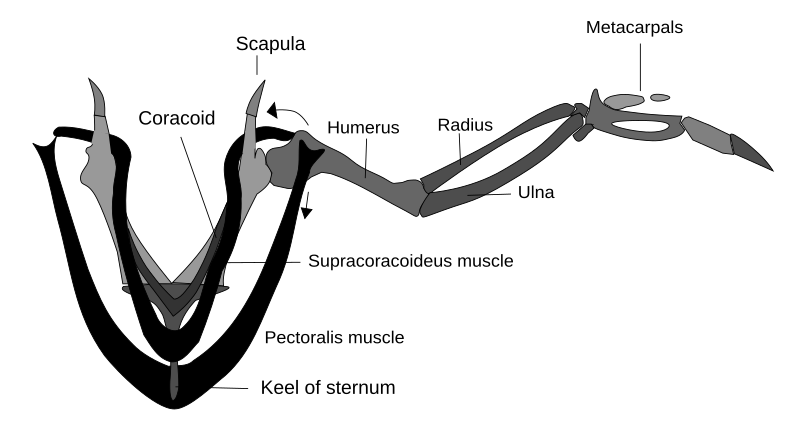
He has a tear in his right wing. It looks to me like a small predator, a cat maybe, caught him around the front of his wing, behind the wrist, and he jerked away, tearing the soft membrane between the humerus and radius, also breaking the thin ligament that spans this space. Through this tear, you can see the radius and the broken ligament, which is shriveled against his wing and looks like a wire.
I treated this area with the ointment several times, usually before bed, after he had another bath. Perry has been spending his time alternating between being held, resting in his kennel, swimming in the tub, and staying in a drop-pen outside---which is equipped with a choice blanket and a waterer for him to get in, and drink from.
He has been drinking well, outside from his dish, and in the tub. He moves well also, flapping his wing, and waddling and swimming. However, he cannot fly, and I doubt will ever be able to again. He is stuck being a pet duck, from now on, and I think that will go pretty well, because he seems to be warming up to us (me, anyway) and his situation.
I have two concerns right now:infection, and the fact that he is apparently not eating, or not eating well.
Looking at the food issue, I have given him greens and chick starter, along with various tidbits from the table and pantry. I have no proof that he has taken any of the greens (administered to him in his water and tub), though he might have taken some of the chick starter last night---I left the bowl in his kennel and he tipped it over and made a mess, however there were crumbs in his bill, and so maybe he got a bit down.
I've tried hand-feeding him, and just plunging his bill into the food, and while the latter method worked better, he still spat out pretty much everything I gave him. Viciously. Despite this, he appears to be getting along alright, and seems of normal weight.
Now, as for the infection problem: I noticed last night during his bath that the forearm muscles were hardening, and inflamed just slightly. It bled a little as he cleaned it during his bath, and I washed it and treated it as usual. This morning, it was even harder, and notably more swollen. So we opted to give him a shot of penicillin, which I just injected into his breast. I gave him 1 cc. Hopefully this will help. He's a fierce little thing, and his wing doesn't seem to bother him in the slightest, however if it gets any worse it will become a real problem.
-
Oh, and he is officially a male ruddy duck, in winter feather-garb. It took me a while to decide, but I'm now reasonably convinced that's what he is.
-
I'll post some pictures of him soon!